

WHY IS
authenticity
SO HARD?
IN 2020, WE INVESTIGATED.
Get your copy of THE AUTHENTICITY CODE: Behind the Fable, Failure, and Future of Authenticity at Work, or listen to the audiobook.
There’s no clear definition. We only measure it via via subjective perception. And the truth is that the maxim bring your whole self to work asks for something that might not even be welcome. Many people—based on visceral, personal experience—do not believe that they can be authentic in the world.
In THE AUTHENTICITY CODE: Behind the Fable, Failure, and Future of Authenticity at Work, authors Casey Erin Clark and Julie Fogh dive into the complexities at play—from defining what “self” actually is, to whose authentic presence we view as leadership material, to the exhausting reality of code-switching—and offer a new framework: reimagining both concept and execution for a better future of work.
Authenticity sounds great in theory,
but it’s incredibly complicated in practice.
Watch our Authenticity Town Hall, featuring performances, our “un-panel”, and many, many special guests.
You've been told to "just be yourself."
You've been told that if you show up authentically — with confidence, with your whole self — the right opportunities will follow. That authenticity is the key to belonging, to leadership, to finally being seen for who you really are.
So why does it so rarely work that way?
We've been sold a fantasy. The promise of authenticity sounds like liberation. In practice, for most people, it functions more like a trap.
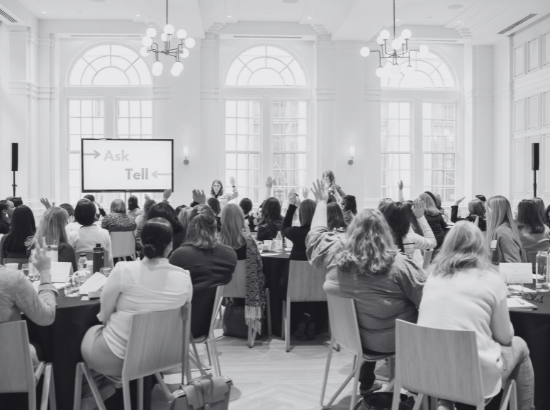
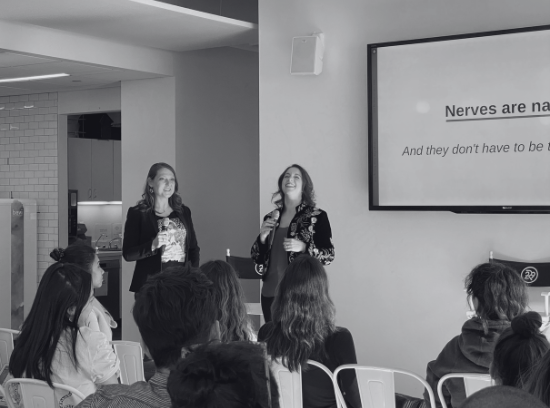
We’d already spent many years working with hundreds of clients across industries before writing this down: the problem with authenticity isn't that people lack it. The problem is that we've fundamentally misunderstood what it is and how it works.
Authenticity doesn't exist in a vacuum. It requires an audience. And that audience brings a brain wired for survival — making snap judgments, confirming existing biases, seeking the comfort of the familiar, and telling itself stories that feel like truth.
The moment we acknowledge that authenticity is always a relational act, the entire popular framework collapses. "Just be yourself" is not just unhelpful advice. It's structurally dishonest.
The Authenticity Code moves through three acts. First, an examination of how we actually process communication — the gut brain and the reasoning brain, the halo effect, affinity bias, and the way our brains will work overtime to avoid the discomfort of genuinely seeing someone who doesn't match our existing story. Second, a clear-eyed autopsy of why authenticity fails — in three forms (the One True Self, the Unfiltered Self, and the Aspirational Self), each promising something it cannot deliver, each placing the burden of the problem entirely on the individual. Third, and most crucially, a new framework: Functional Authenticity.
Functional Authenticity is not a softer version of "just be yourself." It's a complete reframe. Authenticity is not an individual achievement. It is a community practice, and it requires the right conditions to exist at all. Those conditions are built — or destroyed — across five pillars: Values, Behavior, Perception, Trust, and Culture.
The secret ingredient running through all of it is power. Who gets to be authentic without consequence? Who is punished for it? Who has to code-switch, perform effortlessness, or make themselves smaller so that someone else's gut brain stays comfortable? The personal development industrial complex — the self-help machine that sells solutions to people it first convinces are broken — has a vested interest in keeping that question unasked.